 |

 Twin Cities Metro Area |
||
|
|
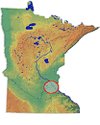
Overview of Environment and Archaeology Geography (map) Topography and Environment Precontact Archaeology (site map) Historic Archaeology (site map) Rivers are the outstanding geographic features of the five Minnesota counties (Hennepin, Ramsey, Anoka, Dakota and Washington) included in the Twin Cities Metropolitan Area. Here the Mississippi pours over the only waterfall in its entire length and is joined by the Minnesota River from the west and the St. Croix from the northeast. A lock now brings watercraft past the Falls of St. Anthony to the upper harbor, in downtown Minneapolis.

|
||
|
|
Below the falls, the banks of the river rise steeply, forming a narrow gorge, and it is joined by Minnehaha Creek. This stream rises in a cluster of lakes to the west of Minneapolis. As it approaches the Mississippi, it pours over a scenic waterfall.
Farther on, at the mouth of the Minnesota River, the U.S. Army established Fort Snelling in the early 1820s. At this point the Mississippi makes a sharp turn and loops east and north through downtown St. Paul.
At St. Paul, the Mississippi turns to the southeast and enters a majestic valley, lined by bottom lands, backwaters, terraces, and bluffs. Between St. Paul and Hastings, Minnesota, many of the low-lying islands and marshy areas in this wide valley have been flooded since the building of the Hastings lock and dam in 1931. Opposite Hastings, the St. Croix River flows in from the east. It rises in northwestern Wisconsin, and for most of its length it is the boundary line between Minnesota and Wisconsin. Below the mouth of the St. Croix, the Mississippi River becomes the state boundary.
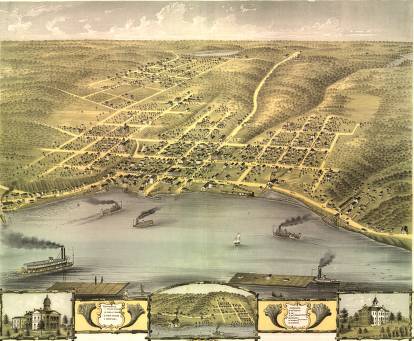
The rich stands of pine in the St. Croix Valley drew lumbermen from New England as soon as the land was ceded by the Dakota and Ojibwe Indians. Stillwater, Minnesota, an early lumbering center on the St. Croix, is now part of the Twin Cities Metropolitan Area.
Like the rest of the upper Mississippi Valley, the Twin Cities Area is a dynamic landscape. Its northern edge is crossed by a wide ridge of glacial deposits known as the St. Croix Moraine. Part of this now forms the Anoka Sand Plain. Farther to the south, the glacial till covers a layer of hard limestone and a thinner layer of shale. Both of these rest on a thick deposit of soft sandstone. As glaciers have advanced and retreated during past ice ages, their melt waters have carved many different channels through the soil and rock. Those seen today were made by the modern Mississippi and St. Croix. Some 12,000 years ago, at about where downtown St. Paul now stands, the Mississippi cascaded over a limestone ledge into a deep valley formed in an earlier age. Fed by torrents of melt water, the fall reached from bluff to bluff and was many times the volume of Niagara.
As centuries passed, the shelf of hard limestone cracked and fell as falling water wore away the soft sandstone beneath it. Gradually the waterfall moved upriver.
|



|
|
|

|
|
Over thousands of years early Indian people left countless traces of their presence throughout the Twin Cities. Early observers and cultural resource surveys conducted in recent years have identified some of these sites, but only a few have been scientifically studied. Most of them are now gone. Native Amercan traditions tell us that the spiritual power of St. Anthony Falls was greatly venerated, but no material evidence of this remains.
Archaeology has also been done at two sites on the Minnesota side of the St. Croix River. The Harvey Rock Shelter north of Stillwater was investigated in the 1930s, and in the 1990s evidence of an Archaic bison kill was found at the Cross Site, just south of Marine on St. Croix. But only among the chain of lakes that make up the Rice Creek Drainage Basin in Anoka County have undisturbed Woodland habitation sites in the Twin Cities Area been carefully studied with modern techniques. For an in-depth look at the archaeology done at that place, see 21AN106.
Europeans imposed new patterns on the landscape and brought different lifeways. From the material record they left in the earth we can learn vital facts about daily habits and about the complex urban and industrial systems through which they have related to the natural world. The field for historic archaeology is almost unlimited in the Twin Cities, yet comparatively little has actually been done.
Only in recent years has archaeological evidence been used in studying the development of the Twin Cities as an urban center. Projects along the Minneapolis riverfront have led the way in this effort. Extended information on archaeology that has explored the development of industry at the Falls of St. Anthony can be found among documents in the Sources section of this web site. The stories of two other city sites, the Bridgehead and the Federal Courthouse, both in Minneapolis, are described here in greater depth. Significant archaeology has also been done at the Washington Street Residential District in St. Paul. Although by necessity this kind of urban archaeology has been conducted on an emergency basis and without a clear research plan, it still has given fresh glimpses into the lives of working people and immigrants in the expanding Twin Cities of the 1880s and 1890s.
|





