 |

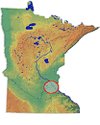
 Twin Cities Metro Area |
||||||||||||||||||||||
|
|
|
||||||||||||||||||||||
|
|
In 1996, archaeologists examined the site of the planned new Federal Building in downtown Minneapolis. An archaeological excavation was conducted to ensure that no important cultural information was lost during construction. The dig revealed fascinating information about how ordinary people used to live and work in the Twin Cities in the last decades of the 19th century.
|
 |
|
|
|
|||
|
|
 Foote (1892) map showing the project area
|
The site lies between Third and Fourth Streets and Third and Fourth Avenues in the heart of the old city. Historical maps showed that the block had been occupied by both houses and businesses during the late 1800s. Using land records, city directories, historic maps and plans, researchers slowly built up an image of the types of people that used to live and work in this part of Minneapolis.
|
|
|
|
|||
|
|

|
Archaeologists decided to investigate the remains of five modest frame houses
dating between the 1880s and 1903. They had some questions that could only be
answered through a combination of archaeology and primary historical
research:
|
|
|
|
 A.M. Smith, ca. 1891. The five houses investigated are in the upper left hand corner of this image.
|
|
|
Step 3: Acquiring a License to Dig
Step 4: Excavation and Data Collection
 The Federal Courthouse Site under excavation.
Data Recovery Excavation/Sampling Plan
|
|||||||||||||||||||||||||||

|
|
|
|
|
 Sanborn (1885) map showing the project area.
|
 Plan of the project area showing feature locations.
|
|
|
 Transfer-printed and banded everyday tableware
|
 Patent medicine bottles, embossed with pharmacy names
|
|
|
Children who lived in the houses long ago left buttons off their clothes, and some of their toys behind.
|
|||
|
|
 Glass and tableware |
 Buttons and toy marbles |
||
|
|
 Wine and soda bottles
|
|||
|
|
 Feature 2: Cistern behind #328 Fourth Avenue South
|
From historical records, we know the names of the people who used to live here. They included included the family of Irish-born Daniel and Mary O'Sullivan, a tailor by trade, a Canadian teamster by the name of Mark Turcott, his wife Blanche and toddler daughter Eva, the Doyles headed by another tailor by the name of Martin, both he and his wife second generation Irish from the eastern seaboard, and by 1900, the Clark family the father of which was an Irish papermaker named Edward. His wife, Kitty, was born in New York State.
|
|
|
The features at the Federal Courthouse Site contained material from the backyards of the houses, plus whatever had fallen in while the areas were used by the house occupants. The artifacts reflected the wide variety of consumer goods available to working folk in Minneapolis around the turn of the century.
 Bridge Square, 1900. |
 Feature 2: North Profile during excavation showing bottle In Situ Here we see a nearby commercial district where Kitty and Edward Clark, who lived in one of the houses excavated at the Federal Courthouse Site, probably did some of their shopping.
|
|
|
Some of the artifacts found included animal bones from dinners eaten by the O'Sullivans, Doyles, Martins and other families who lived here over 100 years ago.
|
|||
|
|
 Animal bones recovered during excavation.
|
Quite a variety of foods were eaten by the working people of Minneapolis. The families at this site ate beef, pork, lamb, chicken and turkey. At least one family ate duck and rabbit as well. Cuts were mostly the high-yield, mid-priced pieces that reflected both the economic resources of these hard-working people, and the tastes of the day. There was almost no game, although oyster shells as well as a large number of fish bones were found, mostly from pike.
|
|
|
Other information about the food eaten by our house residents came from pollen analysis. The faunal remains were judged so important that the archaeologists commissioned a special expert analysis. See: the Faunal Report.
|
|||
|
|
Important data about health, sanitation practices and also about what plants were eaten by people at this site was recovered from doing palynology, or pollen analysis. Lots of information came from the material contained in the privy. For example, pollen showed that cereal grains such as maize and buckwheat were eaten. At least one medicinal plant, an herb known as "feverfew" was used as well.
|
 Feature 3: Privy behind #328 Fourth Avenue South
|
|
|
Health information at the site included evidence for changes to sanitary facilities in Minnesota cities of the day. In the 1870s, we know from historical records that sanitary ordinances were passed regulating privy use and requiring regular removal of night soil. Scientific analysis showed minimal parasite presence in the waste in this privy. Sewers were widely available by the 1890s, and most privies were filled in and closed at this time. There is a lot more information we can learn about this aspect of life in the 19th century Twin Cities. See: Twin Cities Sanitation History, by Sigrid Arnott.
The Federal Courthouse Site provides insight into the lives of women and children who lived in the late 19th century city. Tiny clues to the small duties of everyday life include: straight pins, eyelets, grommets, thimbles and buttons.
|
|||

|
|
 Can't you see Mrs. Doyle sewing by lamplight?
|
Two of the men who used to live here were tailors. They probably didn't work at home because there was not nearly enough sewing-related material found to account for commercial-level sewing. Rather, these objects reflect daily mending, probably by women.
|
|
|
Little children who once lived here left behind broken toys for us to find. Parts of tiny tea services, broken porcelain doll heads, arms and legs (dolls of the period generally had cloth bodies, which an archaeologist wouldn't find), marbles, bits of slate and slate pencils, and, interestingly, a harmonica were unearthed during the dig.
|
|||
Artifacts Related to Children
| PROVENIENCE | DOLL PARTS |
TOY DISHES |
MARBLES | OTHER | LEAD PENCILS |
WRITING SLATES |
TOTAL | |
| Feature 2 | ||||||||
| Layers A-D | 15 | 3 | 1 | 1 | 3 | 1 | 24 | |
| Layer F | - | - | 1 | - | 3 | 1 | 4 | |
| Feature 3 | ||||||||
| Layer A-D-E | 19 | 1 | 3 | 1 | 5 | - | 29 | |
| Layer B | 2 | - | - | - | - | - | 2 | |
| Feature 5 | ||||||||
| Layer C-D | - | - | - | - | - | - | 0 | |
| Layer E | - | - | 1 | - | - | - | 1 |
|
|
The End of An Era In later years, the character of the area changed from a largely Anglo-Irish and Canadian ethnic mix to Scandinavian and then to a non-residential commercial use as the downtown slowly evolved over time. Eventually, the houses were torn down in about 1903 to make room for further development of the block. This picture of the nearby Gateway area shows just how much the residential character of this district had been destroyed by the 1920s. Archaeological excavations at the Federal Courthouse Site made important contributions to our knowledge about life in Minneapolis around the turn of the century. The emerging (or aspiring) middle class had access to a wide variety of consumer goods, including "luxury" items such as pretty tea wares and pressed glass table pieces.
|
|||
|
|
 Luxury tableware. |
 Family dining.
|
|
|
The transition from lamplight to electricity and from outdoor sanitation to indoor plumbing is also evident in the artifacts and features found here. This gives interesting insights into the impact of technological changes on the lives of ordinary people between 1880 and 1903.
|
|||
|
|
 Milk glass lamp globe
|
 Gaslight globe (glass) and battery core, and example of early electrical use at the Federal Courthouse Site.
|
|
|
As America grew into an adult industrial society, so too city administration and regulation was forced to keep pace to serve new needs of the populace. Sanitary regulations and health ordinances, development of commercial and administrative structures, health and safety legislation, and the expansion of city services all contributed to improving the overall quality of life for many, many people. At the Federal Courthouse Site, we see a microcosm of life in late 19th century transition. Two tailors who lived there represent the old craftsman tradition of European and the earlier Eastern Seaboard cities of American. Yet by the late 1800s in Minneapolis, they no longer had shops attached to their homes, but worked elsewhere, likely in garment factories or larger clothiers' shops. This is characteristic of the separation of public and private spaces which occurred in the late 19th century industrializing city. The Anglo-American and Irish immigrants who occupied our five houses are reflective of a specific social class, at a given point in our history - the turn of this century. The families in these modest Fourth Avenue South houses demonstrate the values of people of this income level at the time; the men worked elsewhere, but neither women nor children were employed. Piece work and child labor were not part of their lives the way they were for many poorer and European immigrant families. Here we see, in microcosm, the foundation of Minneapolis' middle class, in its earliest form.
|
|||





