 |

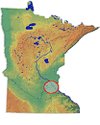
 Twin Cities Metro Area |
||||||||||||||||||||||
|
|
 Overview of the Bridgehead site, Minneapolis 1994.
|
||||||||||||||||||||||
|
|
Before the bank was built, archaeologists conducted a survey to find out what lay beneath the tumbledown factories and broken pavement of what was by the mid-1990s a largely abandoned industrial block. They discovered traces of industry and warehousing, trade and commerce. And, in a corner of the large property, evidence of the homes of men and women who lived and labored in the shadow of the mills. Their findings led to full-scale archaeological investigations in 1993 and 1994.
|
 Minneapolis south quadrangle showing site.
|
|
|
Steps to Saving Our Urban Heritage
|
|||
|
|

|
The Bridgehead site lies between Hennepin Avenue on the southeast with the southwest boundary at First Street North and the northeast boundary at West River Parkway. Readily accessible to the river, and lying adjacent to the first bridge across the Mississippi, the area has always represented a place of commercial importance in Minnesota. Names of area businesses and factories were discovered by searching the land records for the area. Fire insurance maps gave fascinating detail of the changes in occupation and land use over time.
|
|
|
 Pacific Sawmill from Andreas (1874).
|
 North Star Ironworks from Andreas (1874).
|

|
|
Historical research provided clues to the identities and occupations of the people who lived in the houses, saloons and hotels which once stood very close to the sawmill and ironworks. Also located in this area was the City Market, built in 1876, and later the main railway station for Minneapolis.
|
 Sanborn Map showing project area, 1885. |
|
|
 |
Many of the original residential and commerical buildings were torn down in the last half of the 19th century. Brick warehouses, factories and shops had then been built on their lots. But the archaeologists examining historical maps and property records discovered that some of the later structures did not have full basements. There was a chance that the earlier house foundations and traces of outbuildings, wells, cisterns and privies might still be found. |
|
|
Archaeologists were particularly interested in how garbage associated with the houses came to be deposited in backyards and alleys, and when the privies were closed up because they were no longer needed. The archaeological excavations, therefore, also were set up to answer the following questions about 19th century Minneapolis:
|
|
|

|
|
|
|
 City Market Building, ca. 1885.
|
|||
|
|
Step 3: Acquiring a License and Setting Up the Dig
 Archaeological Excavation at the Bridgehead Site, 1994 Before they laid out the site and started to excavate, the archaeologists made a plan for the data recovery process. They decided to concentrate on three main themes relating to the research design:
|
|||
|
|

|
This part of the Federal Reserve Bank property seemed most likely to contain clues about the lives, cultures and material possessions of the people who once resided near the mills along the west bank of the Mississippi River in Minneapolis. Historical archaeologists use a combination of documents, maps, census records and other types of information to enhance their understanding of material remains that they recover. |
|
|
There was a great deal of demolition rubble and disturbed industrial waste covering the site. The excavation was begun using mechanical equipment to strip away the upper levels.
|
|||
|
|

|
|
|
|
 1994 Excavations at the Bridgehead Site.
 Talcott Map, 1857, with addresses of properties.
 Advertisement from Minneapolis Street Directory, 1873-1874. There were three features excavated behind Mr. Calladine's harness shop. These included a rectangular privy, 90 cm X 160 cm in size. |
||||
|
|
 |
This privy had been filled in during the time the Calladine family occupied the property - its upper layers contained dozens of bits of leather, 212 rivets and small metal rings such as one would expect to find in a harness shop. Lower layers contained many tiny seeds, and there was a layer that was almost solidly made up of window glass and some wood, probably the remains of a crate in which the window glass had been placed before it was dumped into the privy.
|
|
|
The other two pits were less easy to identify. One, Feature 17, was semi-circular and may have represented a hole dug for a privy that was never built. It had the second largest number of smoking pipe fragments found at the site - some 39 pieces were recovered.
|
|||
|
|
 Profile of Feature 17. |
 Drawing showing layers. |
|
|
In addition to plain, mostly undecorated bits of broken dishes and glassware, this part of the site yielded some interesting information - the pollen found in soils in these features was analyzed. There were the grass, weed, herb and food plant seeds one would expect, but scientists also identified ornamental bedding plants such as chrysanthemums, lilies and sunflowers which were once planted here, likely in the backyard of the combined shop and family home.
|
|||
|
|
 Recording the Bridgehead Site. |
There was even a bit of holly, remnant of a Christmas long past.
|
|
|
|
|||||
|
|
A privy was found at the rear of what had been #22 1st Street North. It had lots of trash layers in it, as well as a bit of sand and silt that seems to have washed into the pit over time. When city services became available in this area of the Twin Cities was an important question archaeologists needed to answer for investigating the lives of early occupants of these properties. For instance, they wanted to link historical information to finds at the site that reflected its sanitation history.
|

|
|
|
 |
This was especially important in respect to the connection between improving sanitation and hygiene in late Victorian-era cities, and the health of the people living there. The city was growing rapidly, as industry and immigration combined to increase both prosperity and population density. See: Twin Cities Sanitation History, by Sigrid Arnott.
|
|
|
Most of this area had plumbing installed in the mid-1880s, and the people were surprisingly healthy for the time -- almost no parasites were discovered in the privy fill.
|
|||
|
|
At this location, archaeologists discovered dozens of rivets, grommets, bits of leather, and other evidence of the type of manufacturing that went on in the buildings that used to stand here.
|
 |
|
|
|
|||||
|
|
Given the history of the property at 26 1st Street North, it is not surprising that elaborate privy features were discovered. One had a limestone foundation that originally supported a wooden superstructure (Feature 3) and was a rectangular pit lined with wood (Feature 7).
|
 |
|
|
Inside the pit were dozens of artifacts, mainly consisting of household objects. These had been discarded and were mixed with decomposed of organic matter. Near the bottom was a layer full of seeds and eggshells. This helps us learn about the kinds of foods available to people in Minneapolis restaurants and homes in the latter half of the 19th century. Scientific research, including macrobotanical analysis, was carried out on the contents of privies at the Bridgehead Site. As you can see, these layers reflect the presence of a commercial kitchen at this period of the property's use. Obviously the privy was used for the disposal of kitchen garbage, including peach pits, whole nuts and nut shells, coffee beans, butchered bones from cows, pigs, sheep and chickens, as well as fish bone and oyster shells. The upper layers, after the land was occupied by a saloon and later a brewery, do not have the same quantities or variety of food remains.
|
|
|
 Feature 7, Layer C with artifacts in place |
|||
|
|
 Found in privy, Feature 7. |
 Found in privy, Feature 7. |
|
|
The layers from the period of the saloon and restaurant also contain lots of broken dishes (some of them very decorative and relatively expensive wares), table and window glass, fragments of lamp chimneys, a great many pieces of broken bottle glass, buttons, pins, rivets and other items associated with clothing, and a single bullet.
|
|||
|
|
Some of these personal objects -- shirt studs, bits of costume jewellery, buttons, bits of braid and hooks and eyes -- likely came from clothing worn by saloon patrons.
|
|||
|
|
 Personal items discovered at Bridgehead.
|
The fine-toothed combs were used for delousing human hair. Children's objects were also found here. Jewellery, pins, scissors, sewing implements, buttons and braid, would lead one to believe that women lived at the saloon property. It has been suggested that this saloon, a working class establishment near the river and close to factories and mills, had prostitutes on the premises.
|
|
|
Two other privies (Features 11, 12, 21) were found here, both wood-lined and containing lots of wood ash (from the wood stoves that would have heated the buildings), and domestic objects - dishes, glassware, nails and window glass, lots of wood, fragments of shoe leather, and pharmaceutical bottles. See: Artifact Database
|
|||
|
|
 Ceramics discovered at Bridgehead.
|
 Pharmaceutical bottle with embossed lettering.
|
|
|
Many fragments of clay smoking pipes were found in the privies behind 26 1st Street North. Archaeologists are able to date smoking pipes quite easily by the style and manufacture of the items. Even the companies that produced them are known.
|
 Clay smoking pipes.
|
|
|
And, of course, a restaurant and a saloon would have had hundreds of bottles to throw away. Bottles found at this site include soda water bottles (the thick ones with rounded bottoms, a brown whiskey bottle, medicine bottles (the little ones at the top) and a "case" bottle. The latter was molded into a square shape so it would fit with other bottles easily into a wooden packing crate without breaking.
|
|||

|
|
Since the Knoblock family lived above their business at 28 1st Street North, archaeologists expected to find evidence of both the leather-working establishment, and remains of household activities. The period when a saloon stood here should produce the same kinds of materials as were found next door.
|
|
|

|
The privy (Feature 10) and other smaller pits contained lots of household refuse, as well as bits of leather and grommets, rivets and other hardware associated with shoemaking. Also found here were animal bones from food eaten by property occupants over the years. Most of the food remains at this location were from inexpensive cuts of meat, for instance, pigs' feet, and reflect the middle-income status of the shoemakers who lived here.
|
|
|
 Profile of Feature 12; layers E, F, G likely relate to A. Knoblock's occupation period. The dishes used by the Knoblock and Schoenberg families likewise demonstrate their modest income. Nearly all of the ceramic fragments recovered from some areas of the site (Feature 12, for instance) were white, undecorated ironstone sherds. (Decoration tends to make dishes both more showy and more expensive, so archaeologists consider plain white ironstone an indicator of relatively low-income households.)
|
|||
|
|
Also discovered was a quantity of everyday cooking and storage items, such as this stoneware bottle and bowl. Personal items from these layers included a toothbrush, two buckles and some beads.
|

|
|
|
Perhaps the most poignant artifacts found at Bridgehead were broken bits of toys, owned by children now long grown and passed away. Children's toys were found on all of the properties investigated with the exception of the barber's shop.
|
|||
|
|

|
The porcelain doll leg is evidence of the lower-income status of these families. Inexpensive doll limbs and heads were purchased, and cloth bodies to connect them were made at home.
|
|
|
 Brush Electrical Company tower at the Minneapolis Gateway.
|
The increased population led to demands for augmented services, both personal and public. City governments were unable to keep up with the demands placed on their services by altered demographics and increasing residential and commercial density.
|
|
|
Water, power, sanitation, and refuse collection services, with attendant regulations to ensure their implementation, all had to be developed during this period. By the turn of the century, the people at Bridgehead had access to city sewers, gas light and possibly electrical service, and city watermains.
|
|||
|
|
At the Bridgehead Site we see the results of the changes in technology, city government, hygenic standards, and availability of both consumer goods and public services. The people who lived here were not well-to-do by any means. They lived in smelly, dirty proximity to sawmills, foundries, the city market and a host of small manufacturing establishments. Yet they were healthy (very few parasites were present in the privy materials), had access to luxury goods such as costume jewelry and fine china, and ate reasonably well, if the butchered remains of domestic animals found at the site are any indication.
|
|||





